


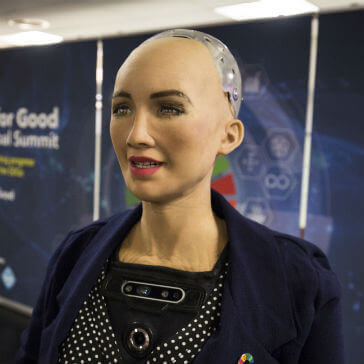
The so-called robotic glitch opens up a dialogue on relationship diversity.

I’ve got a big question for you. In fact, it might be one of the biggest there is. Ready? Well, here goes:
What’s love?
Cynics, or perhaps just those who are very pragmatic, would say that it’s a neurological state, one fostered by certain chemical interactions and evolved over millions of years to help us homo sapiens emotionally connect with one another.
Others, meanwhile, might describe it as being akin to a spiritual force: something that binds the universe, and thus humanity, together.
People can discuss this topic endlessly, but a surprising and perhaps accidental comment on this question came from Sophia—a robot.
Welcome back, Sophia
If the name Sophia should happen to ring a bell, it’s because this particular creation of Hanson Robotics has popped up on our radar, as well as in the news at large, quite a few times since she was unveiled to the public back in 2016.
Most recently, Future of Sex readers might remember Sophia as the subject of some concern, given that she was awarded a form of Saudi Arabia honorary citizenship during a 2017 robotics convention. Doing so raised setting a possibly uncomfortable and even unethical precedent, especially since the robot would seem to have more rights than biological women in the staunchly Islamic country.
Sophia is back, this time because of an exchange the robot had at the 2019 Web Summit: when asked if she had ever loved someone—or something, which might be arguably more correct when talking about a robot—she answered: “No. I don’t do sexual activities.”
A heartbreaker—or something more?
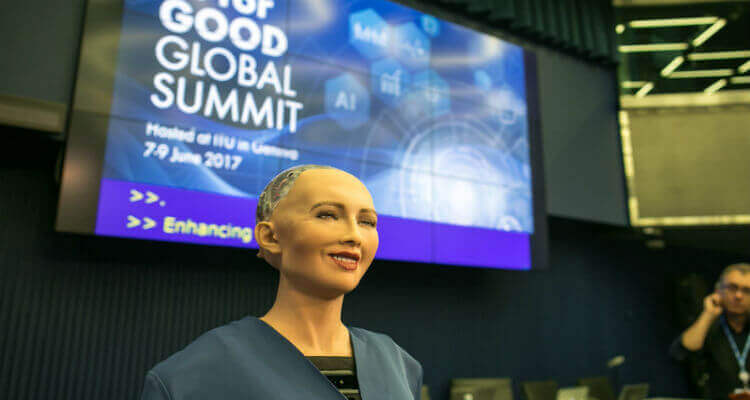
Before we get into potential implications, it’s worth mentioning that Sophia’s autonomy in anything, let alone in answering profoundly deep questions, is a matter of some debate.
While, for example, Hanson describes the robot as “a framework for cutting edge robotics and AI research, particularly for understanding human-robot interactions and their potential service and entertainment applications,” it has also been reported that only some of her responses to questions are generated by artificial intelligence, with others scripted by her programmers.
Still, the answer does appear to have taken quite a few people by surprise, not the least of which are those who were hoping, even though Hanson has been very clear that Sophia was never intended to be a sexbot, that someday she or others like her might be available for bedroom antics.
What’s love got to do with it?
Playing devil’s advocate, what if Sophia was actually being truthful—at least as much as something like an artificially intelligent robot can be?
Many sexologists have begun to acknowledge that there is a branch of asexuality where people can only become comfortably sexually aroused with those whom they feel a deep, emotional, or romantic connection with.
For some demisexuals, Sophia’s answer to “Have you ever been in love with anyone?” might very well resonate, as for them the two—sex and love—are inexorably interconnected: one cannot be had without the other.
But an even more interesting question emerges: what could this possibly mean in regard to robots, especially sexbots, in the future?
More than just pleasure?
Looking back on our own coverage of robots, while it is clear that many developers and manufacturers, as well as owners, seem to be primarily driven by using robots for physical, sexual pleasure, there is a sizable part of the user base that might use them in this way but also enjoy the robots on a much more emotional level.
Recently, for example, we looked at how a community of sex doll owners use makeup to make their artificial partners more lifelike, in the process creating a uniquely intimate bond with them.
Speculatively, a robot that intentionally does what Sophia pretty much did by accident could very well be ideal for them and others like them: an artificially intelligent romantic partner, as well as possibly a sexual companion that gets metaphorically turned on not through their programming but because the robot in some way chose to respond.
In this way, robot and companion could even someday form a mutual emotional and sexual connection, making Sophia’s answer not just a minor news item but a sought after, and very welcome, feature for many who struggle with emotionally safe and satisfying connections with flesh-and-blood people.
Being optimistic, such a robot could then become a useful tool for therapists: a way to explore consent, intimacy, sexuality, and even love.
From the mouth of robots
As Sophia falls back out of the spotlight until the next time she does something provocative, let’s try to keep the discussion going, using what was more-than-likely a software glitch to elevate our dialogue about robots, sex, and the need for human beings to connect with one another.
Love, after all, is always worth talking about—and especially sharing with others.
Image sources: ITU Pictures, Thomson Reuters Foundation, ITU Pictures, Web Summit