


Will ultra-realistic robots be highly attractive… or very creepy?
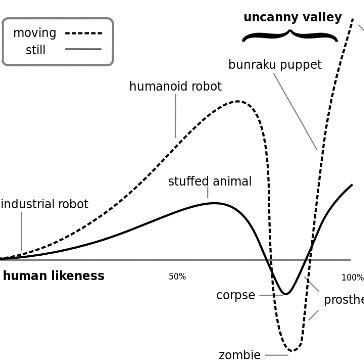
The ‘Uncanny Valley‘ is one of the most important concepts in the development of humanoid robots. Proposed by robot scientist Masahiro Mori in 1970, the basic idea is that we warm more to robots as they look more like us, but beyond a certain level of similitude that is very good but not perfect, we start to be repulsed. As shown in the diagram, this repulsion is amplified by robots that try to emulate human movement.

Image source: WikiMedia Commons
Many refer to the computer-generated characters in the 2004 film Polar Express (see trailer below) as creepy, as they are human-like but not quite human. At the bottom of this article you can see a number of videos of humanoid robots that definitely look a bit weird. While I personally think the issue of the uncanny valley is often overblown, it is a real phenomenon.
So what does this mean for robot love and sex?
In fact one of the hypotheses for why the uncanny valley exists comes from the field of ‘evolutionary aesthetics‘, which looks at what drives our attraction to potential mates. Unusual facial or bodily expressions could denote being evolutionarily unfit, which results in not being sexually attractive.
On the other side of the uncanny valley robots will be able to mimic the full panoply of facial cues of sexual attraction, from blushes and pupil dilation through to winks, sidelong glances and more subtle expressions.
However, before these can be done almost perfectly, it may be better for the designers of attractive robots to keep their expressions simple. A mechanical wink is more likely to kill any attraction rather than heighten it.
Interestingly, more recent research suggests that individuals will react in different ways to the uncanny valley. Personality traits such as anxiety and perfectionism correlate to eerie response, while those who don’t like to be reminded that humans are in fact animals (called Animal Reminder Sensitivity) also are more likely to dislike human-like robots. Age and gender play a role, with younger and female participants experiencing more aversion. There are clearly many cultural aspects to the response, including religious upbringing and the role of robots in your entertainment as a youth.
Further research is now delving into more detail on the nature of the response to human-like robots to enable the design of better – and perhaps sexier – androids and gynoids.
It is worth remembering the expression ‘love is blind’, which describes how we can overlook flaws of all kinds while we are in the extraordinary state called being in love. Robots are not yet sufficiently developed for us to truly fall in love with them. But when they get a bit better at expressing their appreciation for us with all our foibles and failings, we will probably forgive them for some imperfections in their humanity.
Examples of the Uncanny Valley
Polar Express
CNN said that “‘The Polar Express,’ should be subtitled ‘The Night of the Living Dead.’ The characters are that frightening.”
Jules the Robot
One of the earlier “conversational robots” from Hanson Robotics, getting closer to human facial expressions (but not quite). In this clip Jules ponders his sexual identity.
Repliee Q1
This robot can at times look human, but the uncanny valley becomes evident at a few points.
The Uncanny Valley
This PopSci video uses a variety of examples to illustrate the concept of the uncanny valley.
0








Until I can’t tell the difference from a person a robot will be repulsive – how can I be attracted to a piece of machinery?
i can’t wait. robots don’t get old and they don’t get fat. in the words of charlie sheen: BOOM! bring it.
I wonder to what extent the uncanny valley will become less of a valley once personal robots become more mainstream. Will they approach familiarity when they are everywhere, even if we can tell the difference between humans and robots?
Personally, I don’t give the whole ‘uncanny valley’ theory a tremendous amount of credence, as a lot of it is down to personal perception. While some people may be repulsed by less-than-lifelike movement and appearance, others let their minds fill in the blanks, as it were, and don’t have an issue with it. After all, as you’d said, love is blind.
I think when more Gynoids and Androids are visible in society, that’ll get people used to their appearance, and as the technology and aesthetics improve, mainstream society will become less and less averse to the idea of artificial humans.
Interestingly enough, David Hanson of Hanson Robotics, is quoted as saying, ‘The “uncanny valley” is a theory, but people treat it like science’. People’s perceptions towards humanoid robots may not be entirely promising now, but it’ll change.
Wow state of the art technology!