


In countries where it is legal, consistent regulation is lacking.

A recent study from the Internet security firm Comparitech revealed various levels of Internet censorship around the world.
Comparitech’s researchers “conducted a country-by-country comparison to see which countries impose the harshest internet restrictions and where citizens can enjoy the most online freedom.”
The researchers found that bans on “pornography” are in place in countries around the world.
Even where pornography isn’t banned outright, the vague definition of illegal, “obscene” material leads to worrisome shadow bans. This can have a pernicious effect on sex education materials, LGBTQ+-oriented sites, and more.
The countries that top the list
China and North Korea top the list of countries with strong censorship policies. Both countries ban Western social media, messaging apps like WhatsApp, and silence political speech.
Iran is third on the list, due to the government’s strict policing of material from political dissidents, social media platforms, and more.
Next are Belarus, Qatar, Syria, Thailand, Turkmenistan, and the United Arab Emirates.
Bans on pornography are common
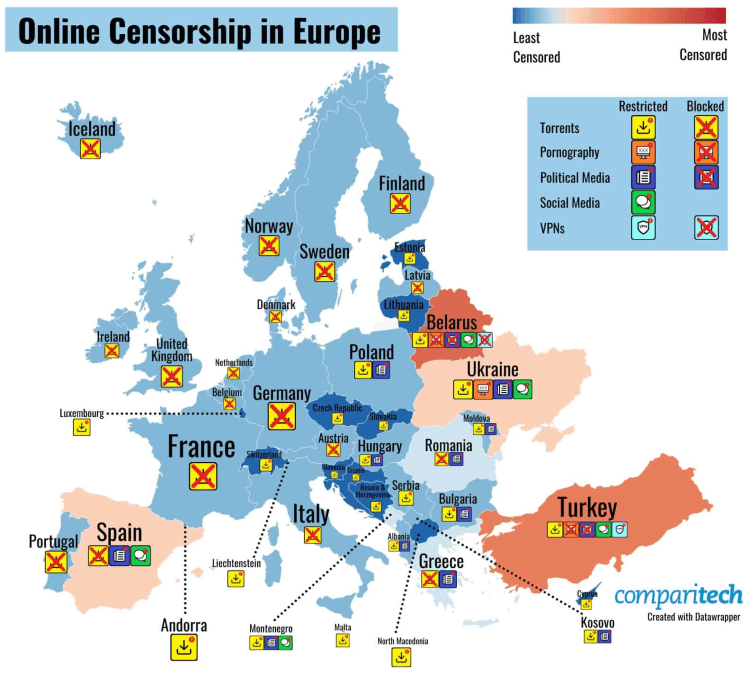
Each of the countries that top the list have a blanket ban of Internet pornography. Thailand experienced the most significant overall rise in censorship, largely because of the government’s overarching ban on anything adult entertainment-related.
Similarly, fourteen African countries restrict pornography, while Uganda, Eritrea, Tanzania, and Equatorial Guinea outright ban access.
In a promising turn of events, Uganda may be forced to ease up on its current restrictions after a recent Supreme Court ruling struck down the country’s anti-pornography legislation.
The countries mentioned above are highlighted in the report as the worst overall offenders, but dozens of additional countries also ban or severely restrict pornography.
The confusion around pornography
Even in countries that don’t restrict pornography outright, the complicated question of what to penalize and what to allow can create confusion.
The United States Supreme Court provided an infamous example of this confusion in 1964. In a decision for a case on obscenity in films, Justice Potter Stewart notoriously wrote that he couldn’t explicitly describe hard-core pornography, but that “I know it when I see it.”
This phrase sums up the problem with countries attempting to censor pornography: no one has ever been able to put together a satisfying definition of what it is and when it’s “offensive” or “obscene.”
Unfortunately, countries tend to respond to this issue by casting too wide a net.
Doing more harm than good
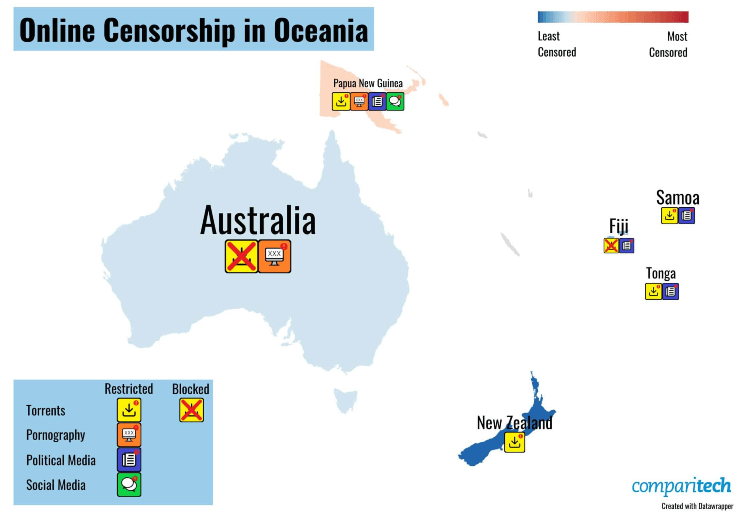
For an example of this over-reach, just look at Australia’s Online Content Bill. Despite being written to criminalize revenge porn sites, the lawmakers behind it may end up doing more harm than good.
Some Australian lawmakers publicly oppose the bill, stating concerns that it may be exploited or used to cast blanket bans in the future.
Look no further than in the United States for too many examples of overzealous anti-porn internet blocking.
In April of this year, Them drew attention to an often-used school security program that’s been erroneously flagging LGBTQIA+ health and wellness sites as porn. The same program was granting students access to hate speech platforms.
Take note
The Comparitech report should make everyone sit up and pay attention.
After all, that’s what it’s there for: to point out how countries like Thailand, Greece, and many others prevent their citizens from communicating with others, expressing their opinions, and learning whatever they want about the world around them.
But another takeaway should be how devilishly easy it is to restrict access in the name of trying to save people.
Images sources: Paul Deluvio/Unsplash, Comparitech