
IVF Technique for 3-Parent Babies May Soon See Human Trials

M. Christian
3 Min Read

New process could end inherited genetic disorders.

A new form of in vitro fertilization could end proliferation of genetic disorders.

Researchers at Newcastle University in the United Kingdom have achieved an important step for an in vitro fertilization (IVF) method involving three people.

As recently reported, the country opened the door to this form of conception by legalizing new types of IVF experimentation in a groundbreaking legal decision. Spearheaded by Lord Howe, an amendment to the 2008 Human Fertilisation and Embryology Act allows scientists to investigate novel IVF techniques with the goal to understand and even prevent inherited genetic disorders.

Theoretically simple

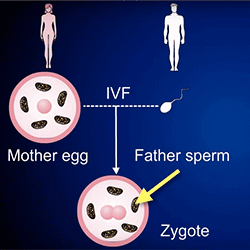
While others have explained the procedure before, it’s worth going over the basics one more time. In essence, the new IVF technique would swap out a mother’s mitochondrial DNA (parent #1) with those of a donor’s egg (parent #2), then this new hybrid egg is fertilized with sperm (parent #3).

This method is appealing to some because genetic disorders can be passed down from a mother’s mitochondrial DNA. Women diagnosed with a potential mitochondrial genetic illness would have a way of giving birth to completely healthy children. Without this option, the only recourse would be to either choose not to have children or play the odds.

Chief Medical Officer for England Dame Sally Davies said, “It would give these women their own children and these families hope, and I believe this is right.”

Practically challenging

While the process may appear simple, making it a reality hasn’t been without hurdles.

In 2010, Newcastle University’s Wellcome Trust Centre for Mitochondrial Disease was able to demonstrate the validity of the process—but only as a proof of concept because the test was performed on eggs that had been discarded from other IVF treatments.

Success within sight

This month, however, the Newcastle University team, headed by Professor of Neurology Doug Turnbull, announced that they had successfully executed the procedure with healthy donor and recipient eggs 200 times.

Speaking to New Scientist, Professor Turnbull said, “We can’t say any procedure is 100% safe… we have to move along respectfully and appropriately.”

Recognizing that there is still much work to do, Turnbull remains enthusiastic about the three-parent IVF technique and its potential for aiding those who would otherwise not be able to have healthy children.“We are working as hard as possible to make this available to patients,” he said.

If all goes well, the UK Human Fertilisation and Embryology Authority could soon be granting permission for Turnbull and his Newcastle University research team to use their remarkable new IVF technique with the very first parental trio.

Image source: RichochetScience

Share This Article
Follow:
M.Christian (they/them) loves nothing better than exploring the intersections of sex and technology—and speculating on the future of both. A highly regarded erotica writer they have six novels,12 collections, 100+ short stories, and 25 anthologies as an editor to their name. Their non-fiction regularly appears in many sites, but they're most proud of being a regular contributor to Future of Sex. Of their erotic fiction, Tristan Taormino said that “M.Christian is a literary stylist of the highest caliber: smart, funny, frightening, sexy—there's nothing [they] can't write about… and brilliantly.” Reflecting their unique ability to sympathetically and convincingly write for a range of genders and sexual orientations, their stories have appeared in multiple editions of Best American Erotica, Best Gay Erotica, Best Lesbian Erotica, The Mammoth Books of Erotica, and others. Their collection of gay erotic fiction, Dirty Words, was a finalist for the Lambda Literary Award. While a majority of their stories have been collected into books like Dirty Words, their fondness for combining sex and science fiction is clearly evident in collections that include Rude Mechanicals, Technorotica, Better Than The Real Thing, Skin Effect Effect, Bachelor Machine, and Hard Drive: The Best Sci-Fi Erotica of M.Christian. As a novelist, M.Christian’s versatility is on full display with Running Dry, The Very Bloody Marys, Brushes, Painted Doll; and the somewhat controversial queer BDSM/horror/thrillers Finger's Breadth, and Me2. M.Christian has worked on the industry’s production side as an Associate Publisher for Renaissance E Books and as a Publisher for Digital Parchment Services. The latter dedicated to celebrating the works of science-fiction legends such as William Rotsler, Jerome Bixby, Jody Scott, Arthur Byron Cover, Ernest Hogan, and James Van Hise. Covering topics like BDSM safety, sexual education, senior sexuality concerns, queer and gender issues, plus reviewing a variety of sex tech products, M.Christian’s non-fiction has appeared on sites like Kinkly, Tickle.Life, Sexpert, Queer Majority, Sex for Every Body, and—of course—their ongoing work for Future of Sex. If there’s anything M.Christian enjoys more than writing, it’s teaching. A featured presenter, sometimes with their friend Ralph Greco Jr, at national sex and BDSM events, they have lectured on kink play (with an emphasis on safety), polyamory, boosting sexual creativity, and erotica writing--for beginners or those wanting to go pro. M.Christian is a cohost on two popular sex-education podcasts: Love’s Outer Limits with Dr. Amy Marsh and Licking Non-Vanilla with Ralph Greco, Jr.
Leave a Comment