

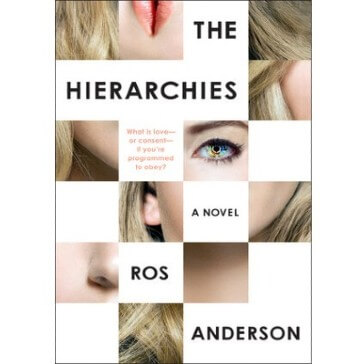
In this exclusive interview, author Ros Anderson discusses the sextech inspiration behind her upcoming book.

Ros Anderson’s debut novel The Hierarchies tells the story of Sylvie.e, an embodied intelligent AI system designed to be the perfect wife.
Sylvie.e is a fully sentient robot, programmed to follow “The Hierarchies”—the strict programming rules to keep her catering to her Husband’s every whim.
But her life, and her story, take a different turn as she challenges domesticity and her “marriage” to enter the world of sex work. This brilliant novel explores the potential of love, relationships, and power with technology.
Sexbot science fiction
Penguin Random House released the book in the United States this summer and the UK release is anticipated for June 2021 via Dead Ink. The reception has been overwhelmingly positive so far—perhaps as it appeals to a current zeitgeist of “sex robot” fiction.
Novels concerning sex robots have come into force over the last few years.
There was Margaret Atwood’s Heart Goes Last in 2015, along with Ian McKewan’s Machines Like Me and Jeanette Winterson’s Frankissstein, both published just last year.
But none of these bestsellers wrote a story recounting the life of a sex robot from the point of view of a gynoid character; something Anderson was keen to explore:
The sex robot is the narrator; it is her story. I was excited about the idea for my story because I could put this female robot, this ‘other’ at the centre a … I could write the diary of a sex doll
Anderson captures Sylvie.e’s voice as an evolving AI system that shows the process of a technological product learning through human experiences—which was no mean feat.
Simple sentences and reflex responses to commands evolve to questioning the meaning of phrases, words, and tone that lead to what could be considered “consciousness.”
When asked whether Anderson referred to forms of existing sextech when designing her fictional world, she clearly answers:
I was interested in AI creativity. What is the creative potential of AI? As a writer I was interested in that, and also other writers’ horror at this idea. The direction of the story definitely changed when I read David Levy’s Love and Sex with Robots. I in my naivety hadn’t thought about these basic possiblities like the development of AI dolls being used instead of sex workers—not just a doll in your private home…
Reading Kate Devlin’s essays also made me consider how sextech could make for a less mechanical view of sex, as well as thinking why it is so masculine focused
One important piece of sextech really inspired her however, and served as a key feature for developing her story:
There was a sexdoll called Samantha at an exposition …she was taken of the display after 24 hours after being mauled and molested by all the visitors – it struck me as a neat metaphor for being a young female in the world—a switch is flipped and suddenly everyone thinks they have a right to your attention, your body—so that was a big impetus
The story of Sergi Santos’s creation Samatha and her treatment at the Ars Electronica fair in 2017 has been a much–discussed news story, in sex tech circles and outside of them.
Pyramid of power
The title of the novel speaks to the strata that dictates who matters in this pyramid of power, and challenges the ideas that “synthetics” are not as important in comparison to biological people. Alongside this commentary, Anderson sees this as part of a wider conversation about technologies’ dystopian or utopian potential:
The book will be characterised or shelved as a dystopia, or a feminist dystopian sci-fi novel but I think we are already here and things are dystopian for all of us right now. It is not necessarily the technology’s fault. Algorithmic bias, racial profiling along with other technologies that negatively and disproportionately affect women… but we need to harness the positive effects.
This debut novel gives a fresh new perspective with Sylvie.e the gynoid’s narrative, while touching on some of the more thought-provoking and polemical conversations around sex robots.
Anderson’s novel provocatively asks some timely questions. Could AI develop sentience and emotions? Would this be ethical? Is a robot wife a desirable outcome of sextech? What about a robot sex worker?
Science fiction has always offered a space to offer contemporary social critiques while envisioning new futures.
But with this novel, it is hard to work out—Utopia or Dystopia? It’s up to the reader to decide.
Image sources: Penguin House