


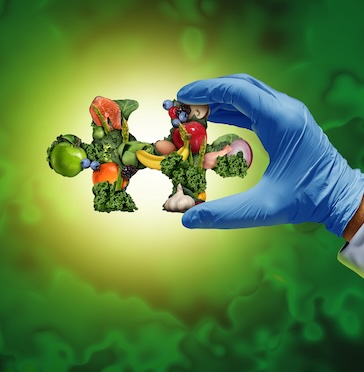
Why not have a blooming-good time with organically grown pleasure devices?

Seed a speculative biology field with plenty of imaginatively tweaked DNA and, in the not-too-distant future, we might be able to pluck our fully-customizable sex toys straight from the ground.
Sound far-fetched or something better left to body horror auteurs like David Cronenberg? The truth is the technology isn’t just feasible, but considering how much work has already been done in the field, it might more accurately be called inevitable.
So, what would organically grown sextech be like, and why might it be more appealing and much less creepy than you imagine?
Cultivating our garden

Over the years, we’ve looked at how genetic engineering might lead to everything from improved birth control options to transforming us into superpowered lovers—as well as uplifting us towards posthuman quasi-godhood,
Not to mention, CRISPR-related research could potentially be used to refashion otherwise run-of-the-mill plants into a brand new species of nearly limitless sexual possibilities.
Case in point, why not begin by optimizing a cucumber for pleasure? Give it something like a cartilaginous spine for enhanced durability and flexibility, then build in a chamber or two into which a set of specifically designed reusable motors and electronics can be easily inserted.
RECOMMENDED READ: Can the Solarpunk Movement Give Us the Sexual Utopia We’ve Been Waiting For?
Naturally, we’d also want to adjust its biochemistry to make it hypoallergenic, then alter inherent juiciness so it’ll secrete any number of arousal-enhancing compounds depending on your excitement level. Not forgetting making it taste like anything you want, including if you’re especially kinky, like a cucumber.
Another great feature of grown-and-not-made sexual devices is their flexibility—not only how bendable they can be made, but all that’s necessary to change its size, texture, color, or anything else about it is a little more genetic resequencing.
Personalization, perhaps made simpler compliments of your favorite artificial intelligence, first reading your DNA and then modifying your garden of organic delights to maximize your excitation to the max—perhaps, as the AI would be reading your subconscious desires beyond your wildest dreams.
Flowers are happy things

But why, aside from its arguably weird-but-also-coolness factor, would anyone want to grow, let alone use, a genetically manipulated organism as a sex toy?
Beyond their infinite changeability, they’d be the ultimate in green technology: once you’re done with it—unless you want a post-orgasm snack—just toss it into your nearest compost bin.
Grown toys would also use less water and resources, far fewer than the most recyclable plastic toys, by requiring just a small plot of land, sufficient moisture, and sunlight. No mining, no refining, no waste, no infrastructure of any kind—except for its reusable motors and electronics, of course.
Another approach to harvesting tomorrow’s sextech devices is to make them neither purely biological nor totally artificial, like the work being done by University of Vermont, Harvard University, and Tufts University scientists who’ve developed what they refer to as reconfigurable organisms based on frogs’ eggs.
“You can think about this like using the different cells [as] building blocks,” Douglas Blackiston, one of the team, told NPR, “like you would build with LEGO or with Minecraft.”
So if the idea of pleasing yourself with a genetically altered descendant of a common-variety cucumber doesn’t turn you on, you might want to consider toys assembled from not-quite-organic, not-really-inorganic materials—something that’d be as warm and adaptable as living tissue while hopefully not feeling or looking disturbingly creepy.
A microcosm of a just and beautiful society

Genetic engineering is one of those emergent, bleeding-edge technologies that often tends to make people decidedly uncomfortable. The thought of it running amok triggering ecological disaster nightmares, fears of breeding so-called superior humans, and fears that we might end up accidentally eliminating what makes us so wonderfully, unpredictably human—the list goes on and on.
But it also holds a lot of promise: treatments for otherwise incurable diseases, elimination of fatal or debilitating genetic conditions, ending pandemics before they can start, feeding the hungry, enabling us to be who we really are, gender-wise to be their true gender, etc. It certainly appears like its positives might equal or even surpass its possible negatives.
The bottom line is, as with every new technology, it’s up to us if genetic engineering turns out to be a problem or a solution—which may or may not include getting it on with something you grew in your backyard.
Image Sources: Depositphotos