


How can remote sensing change your sex life?

In a development that could have wide-ranging implications—and intriguing erotic possibilities—researchers at the Massachusetts Institute Of Technology (MIT) have developed a method of reading human emotions using wireless signals.
The Computer Science and Artificial Intelligence Laboratory (CSAIL) team, made up of Professor Dina Katabi, Fadel Adib, and Mingmin Zhao, presented their new technology at the Association of Computing Machinery’s International Conference on Mobile Computing and Networking (MobiCom) conference in October of last year.
How do you feel?
Before the development of the what the MIT team is calling the EQ-Radio system, the only way to reliably read someone’s emotions was through intrusive, and uncomfortable, body sensors—as in standard lie detection equipment.
What EQ-Radio does is bounce wireless signals off a subject, measuring fluctuations in their pulse rate and respiration.
“Just by knowing how people breathe and how their hearts beat in different emotional states, we can look at a random person’s heartbeat and reliably detect their emotions,” Mingmin Zhao said in a press release.
Remarkable accuracy at a distance
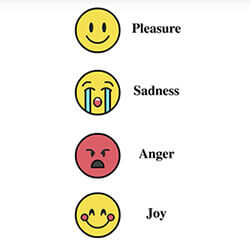
What’s really extraordinary about EQ-Radio is its precision. Using their new algorithm, the team has achieved an 87% accuracy rate in reading emotions like anger, sadness, happiness, and excitation.
Professor Dina Katabi said, “Our work shows that wireless signals can capture information about human behavior that is not always visible to the naked eye.”
The MIT team envisions their technology being integrated into smarthome systems, being used for everything from fine-tuning various forms of entertainment to keeping a digital eye on the mental health of the residents.
“We believe that our results could pave the way for future technologies that could help monitor and diagnose conditions like depression and anxiety,” Katabi added.
The future of reading emotions
While those are two excellent uses for the emotion-detecting technology, other possibilities come immediately to mind. The first would be a tool for law enforcement: giving officers, especially in hostage situations, a critical negotiation tool.
Then there’s sex—and here’s where things really get interesting. We’ve already seen the development and application of an app that monitors the user’s emotional state, and even going so far as automatically “unfriending” those who cause depression and anxiety. So why not couple that technology with EQ-Radio?
This way people could gain not only the ability to know their own emotional, sexual personal reactions, but also those of the people around them. It would definitely be a way to take a lot of the clumsy guesswork out of meeting, and being intimate with, other people.

Coupled with augmented reality glasses, it could also be an invaluable resource for those who feel challenged in judging other people’s emotional states. A handy icon flashed next to a person’s face immediately informing the wearer that they are happy, sad, upset, or—better yet—turned on.
Similarly, the smarthome use of EQ-Radio could be a great way to enhance sexuality. As the system monitors your behavior from everything from masturbation to partner play, it would know when, exactly, to do things like dim the lights, increase or decrease the temperature, or even tweak the performance of any sex tech being used.
And just think of the teledildonics possibilities: as you and your remote partner are enjoying yourselves, EQ-Radio would be able to invisibly synch you both emotionally as well as physically through similar adjustments to the sex tech hardware.
It could similarly be a key component to the development of sexually responsive artificial intelligence and sexbots. When your synthetic playmate reads you as being nervous, it could become more reassuring. When it detects arousal, it knows to proceed. When it picks up on confusion, it knows when to take things slowly—all without needing to touch a control or speak a command.
How do you feel about all this?
While there’s always the potential this kind of technology could be used inappropriately, it could also be a huge help to those needing assistance in reading other people’s emotions. It could also be a way to help develop a healthier, more satisfying sex life.
It all comes down to how you feel about it—and if you’re unsure about that, then this is where EQ-Radio might just come in.
Image sources: MITCSAIL, Frank Behrens