


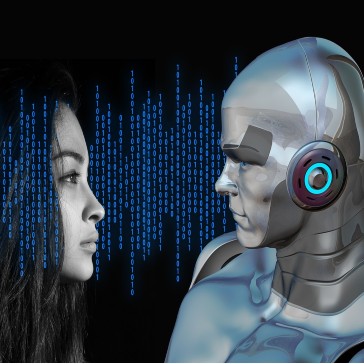
Mimicry and emotional behaviors are enough to create a deep, mutual bond.

“If love was all about certain behavioral patterns, you could hire an actor to ‘go through the motions,” argue moral philosophers Lily Frank and Sven Nyholm from Eindhoven University.
But, by common conceptions, this would not be real love, however talented the actor might be. What goes on ‘inside’ matters a lot as to whether mutual love is attained or not.
If you take a closer look, these concerns are not as convincing as they seem at first.
Rethinking love and relationships
What persuades us that our human partner is satisfied with the free-choice conditions and mutuality mentioned above?
It is impossible to answer that because nothing else proves it apart from behaving and acting like they are in love with us.
So, if robots can mimic or go through the same behavioral emotions, is there any reason for denying the sincerity and genuineness of their love and affection? Philosopher Michael Hauskeller clearly emphasizes this point in Mythologies of Transhumanism (2016).
Freedom of choice
The same applies to free choice. It is still controversial as to whether or not human beings have freedom of choice and not an illusion of it.
For instance, if you want to know if your human partner really chose you, it is hard to determine that apart from some behavioral actions that suggest this, such as their willingness to break up with us when we disappoint or upset them.
The search for metaphysical truth
From this, it is evident that the basis of our beliefs about the degree of our partner’s commitment to us only lies in their detectable functional and behavioral patterns and not in a deeper imaginary metaphysical truth, as many believe.
Image sources: geralt, TheDigitalArtist