


Joshua chatted with a virtual recreation of his fiancée on the site Project December.

Although the Spike Jonze movie Her felt futuristic at the time of its release, artificial intelligence (AI) is inching ever closer to Samantha’s human-like technology.
At the moment, chatbots, both sexual and platonic in nature, are the closest approximation we have to seemingly-sentient AI companionship.
Chatbots mimicking the dead
Last month, the San Francisco Chronicle reported on a 33-year-old man who had a virtual conversation with his dead fiancée.
The man, Joshua, created a chatbot version of his fiancée on the site Project December by uploading old messages she had sent and writing a short introductory paragraph about her.
He hadn’t expected much from the conversation, but was soon pulled into an intimate, bittersweet exchange with a convincing likeness of his fiancée, Jessica.
Over the course of a months-long conversation, Joshua reported that his mental health had improved, and that “the survivor’s guilt that had plagued him for eight years seemed to be fading.”
Although Joshua acknowledged that the chatbot occasionally made glaring errors and didn’t perfectly replicate Jessica’s personality, he was nonetheless profoundly impacted by the chatbot’s presence.
Fearing for the future

Project December, the site that brought Jessica’s chatbot-likeness to life, is powered by GPT-3, an advanced AI software created by OpenAI.
OpenAI, an AI development company that was co-founded by Elon Musk, recognized GPT-3’s capabilities and severely limited its availability to the public.
Although GPT-3 is perhaps the most advanced AI software available to beta testers, other AI chatbots have been operational for years.
Other chatbots
Those familiar with the latest advancements in AI are well aware of the rise of chatbots.
Multiple projects have been in development for years, including Kokeshi the interactive love doll and virtual girlfriend, and Melody, a Chinese chatbot built to gather information from patients before they see a human doctor.
However, any experience with chatbots isn’t perfectly convincing yet.
A quick virtual chat with Kokeshi [NSFW] reveals that overly-complex questions result in canned responses such as “Just come over and whisper your wildness into my ear. Book it.”
The future of companionship
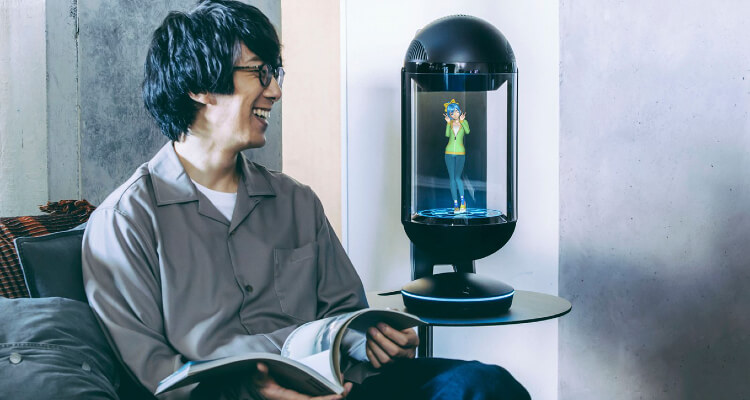
AI software is also being utilized in more immersive soft- and hardware projects to provide companionship.
During the pandemic, Japanese virtual assistant developer Gatebox Inc developed a work-from-home holographic companion for its employees. The hologram could encourage timeliness, provide light-hearted support, and remind its owner of deadlines.
And the sex doll company Abyss Creations has created an interactive doll head that makes convincing facial expressions. The head is equipped with AI through the RealDoll X app [NSFW], which allows the user to fully customize their companion’s personality and voice.
As voice assistant and chatbot technology continues to improve, along with remarkable gains in AI personalities designed for romantic and sexual companionship, perhaps more people will embrace artificial intelligence as a means of loving, grieving a loss, repairing a broken heart, and learning to move on.
Image sources: Andrew S, Mike MacKenzie, Gatebox