


Two projects, one real and one imaginary, envisioned a future of sex we’re still waiting for.
The Cybersex Duo System

In 1992, Future Sex magazine took a speculative look at what cybersex gear might look in the years ahead. Conceived by writer and software designer Mike Saenz, the Cybersex Duo System (CSEX 2 System) consisted of a pair of male and female cybersex suits.
“You may consider this to be a work of erotic science fiction or a blue print of Future Sex,” Saenz wrote.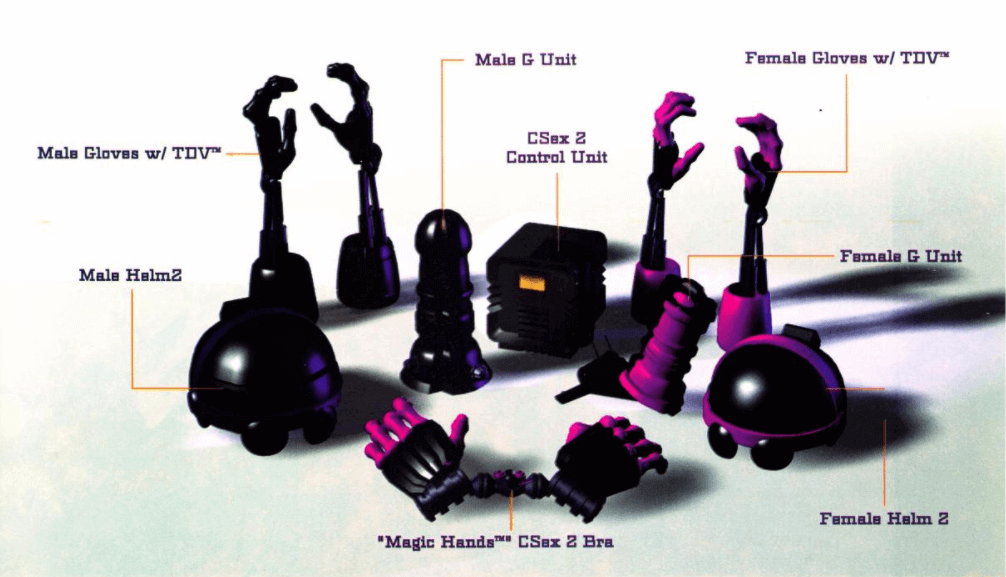
The above image shows off the different equipment envisioned. Together making up the fantasy CSEX 2 System, they offer 3D stereo H.U.D., a TDV Tactile Data Playback System, simulated skin components, and 3D audio.


Inside the control helmets are stereoscopic displays, allowing each model to hypothetically see their cybersex partner.


Many thanks to Kyle Machulis (qdot) and Mike Dank (famicoman) for uploading copies of the 1990s Future Sex magazine to the Internet Archive. The CSEX 2 photos are from the second issue.
CyberSM
In 1993, the CyberSM suit premiered as the first of its kind: a full-body multisensory communication system. Developed by artist and professor Stahl Stenslie and Kirk Woolford, it connected users in Paris, France, and Cologne, Germany.
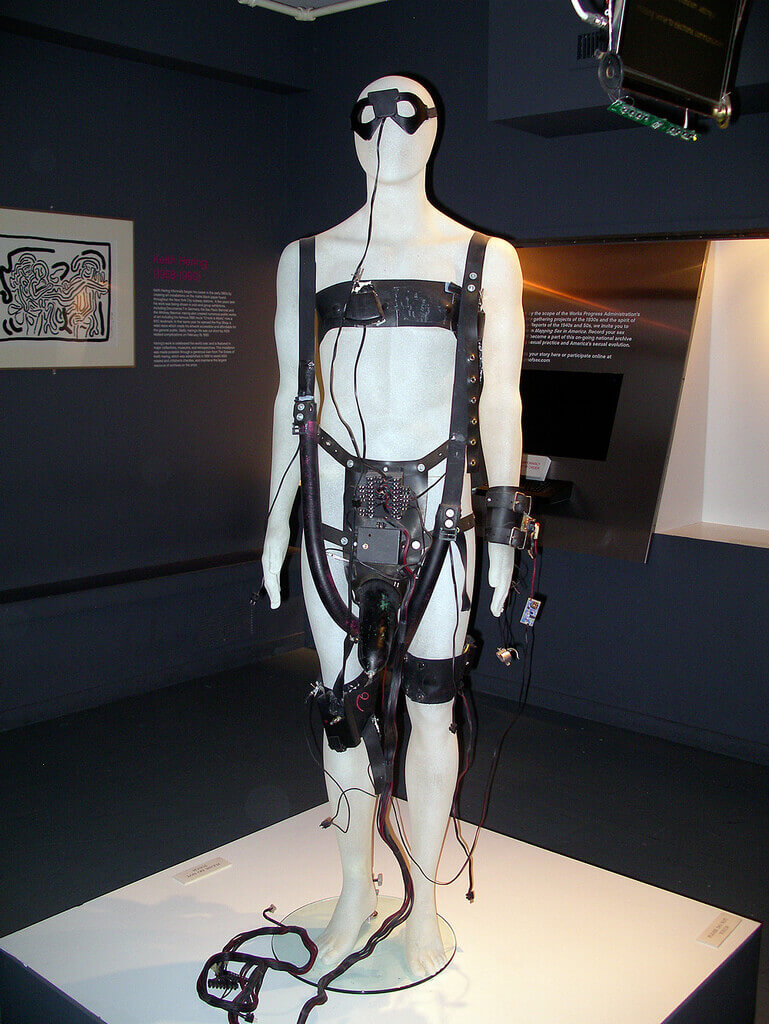
Above the teledildonics suit is shown on display at the Museum of Sex in New York City in July 2008.
“CyberSM allows users to build ‘virtual bodies’ and then anonymously converse and control physical stimulation provided by the CyberSM suit of another user,” said press material from the display.
Better yet, check out CyberSM in action by viewing the NSFW video below.
In a statement released by the Museum of Sex, Stenslie said that despite strong media interest in the 1990s, nothing like his CyberSM project has been created since.
The ways we currently use the Internet are not even remotely close to utilizing multisensory communication like CyberSM did. One of my goals was to use the arts as a subversive arena to critique the blind belief in modern media. In 1993 we were at the height of the hype surrounding virtual reality. Then the project created an even greater hype–the dream of instant pleasure gratification through the technology of cybersex.
CyberSM was almost eaten alive by hungry, stunned journalists. On the one hand, it narrowed the scope of the project; on the other, it permitted me to experiment with Real Media. Between 1994 and 1996 the project appeared in all major European magazines and on television.
Teledildonic sex toys do exist, but Stenslie is right that we’re nowhere close to having a suit similar to CyberSM, or even CSEX2 for that matter.
But the infamous teledildonics patent expires in August 2018. Maybe we won’t have to wait too much longer for something like the above systems, or perhaps the Tesla suit, to come to market.
Image sources: Future Sex magazine, Chris Ainsworth