

Dr. X. Treme teaches us how to program sex toys.
If you’re keen to hop on the DIY sex tech bandwagon, listen up! Today Orgasmatronics launched the Master Beta Kit, which includes everything a newbie needs in order to learn how to program almost any vibrator.
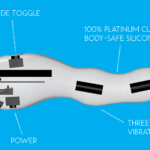
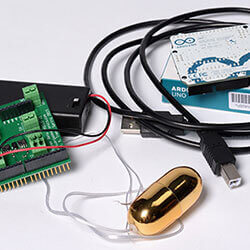
Along with a step-by-step tutorial, it comes with a circuit board, an Arduino UNO board, a USB cable, a bullet vibe, and a AA battery pack. Early birds can snag the kit for $69 at the product’s Indiegogo crowdfunding page before it retails for $89.
The timing is impeccable. In the coming year, we’re expected to see a jump in crowdfunding campaigns for Arduino-powered sex gadgets. Arduino is a company that offers open-source hardware and software for creating and controlling robotic devices. Comingle’s mind-operated dildo, the Mod, and its Electric Eel condom already use these tools to deliver customized pleasure.
You, too, can become an erotic engineer—no coding or soldering experience required—and be ready for the hackable sex gadgets set to hit the market.
Sexing up Science
The Orgasmatronics CEO, who goes by the moniker Dr. X. Treme, admits there isn’t a lot of interest for hacking sex gadgets. His aim is to get people excited about the STEM fields—science, technology, engineering, and mathematics.
“This isn’t a real sex toy, this is a kit for education,” he said. “Programming a sex toy, I think, is mostly a silly gimmick and it’s one of those things where if the goal is to have a fun sex toy that gets somebody off… You can buy something for $8 that’s going to be fine.”
“That’s part of why I think of this totally as an educational project, that if your goal is to find an amusing way to learn some good technology that has a million applications. And it’s a gateway to getting deeper and deeper into it, maybe even becoming an engineer.”
Dr. X. Treme, who has a PhD in applied physics from Yale and a double degree in math and physics from Berkeley, expects to see arts and robotic projects crop up thanks to the straightforward Master Beta Kit.
Yet despite what the physicist has said, there are folks who do want to hack their sex toys. He’s held a not-safe-for-work Arduino workshop at a Denver hackerspace for about a dozen people in 2014.
In May, he’ll run two more classes in New York City for groups of up to 20 people, with tickets already on sale for the event at the hacker collective NYC Resistor. Workshop dates for Boston and San Francisco are yet to be determined. If you don’t live near these locations, people who contribute $1,500 or more to the crowdfunding campaign can get Dr. X. Treme to visit them for a class.
Stay tuned! We’ll post the second part of our interview with Dr. X. Treme and his views on patents next week.
Image source: Orgasmatronics