


Mind sex and long-distance orgasms could be right around the corner.
 |
How will intimacy change when you can literally get on the same wavelength as your partner?
We may soon find out with neuro-headsets that can record and send a person’s brainwaves to a computer. This was one of several intriguing ideas shared by futurist Scott O’Brien at our Future of Sex Meetup last month.
A leading expert in augmented reality, O’Brien spoke about the way new technologies are broadening our scope of the world, and in turn how humans may connect to one another.
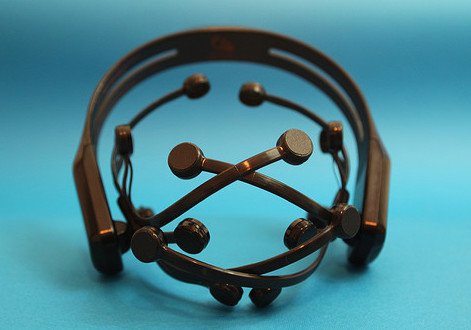
In one example, he played a video of performance artist Marina Abramovic and interviewer Brian Lehrer wearing wireless Emotiv headsets. These devices— dubbed as “wearables for your brain” —use electroencephalography (EEG) to measure electrical activity.
Via the EEG headgear, a computer received each person’s unique brain patterns. Then, it displayed them on a screen to show when their wavelengths matched.
Stronger connections
For people in romantic relationships, being able to read and align your partner’s brain waves with your own could foster deeper connections and more empathy.
How many times have you been in an argument and felt like the other person didn’t understand where you were coming from? Or you just couldn’t grasp why something that seemed trivial to you meant so much more to someone else?
It can be challenging, not only to express one’s emotions but to have them be truly understood—even by a loving partner. However, O’Brien believes that in the future couples will be able to tap into this tech and use it as a bonding tool.
One day it may also be possible to read brain waves remotely. While your lover is at work and you are doing the groceries, you could get some insight into what their mood will be at home that evening.
Don’t worry, for people who want to keep their wavelengths to themselves, O’Brien envisions the situation as one you must opt in to. No one could access your brain patterns without your permission.
Long-distance mind-gasms
But what if you wanted to take it a step further? The technology isn’t around right now to send your lover a long-distance brain orgasm, yet in the next few decades it could become a reality.
Already, an orgasm has already been stimulated in a human through direct neural interfacing, says O’Brien. One incident occurred by accident during studies to predict epileptic seizures.
For people with mobility challenges or who suffer chronic pain, targeting the brain first offers promise for hot new sexual experiences. It won’t be necessary to move your body in a certain way in order to climax, or even feel connected to your partner.
You could share very real and very erotic sensations with your minds. With neuro-headsets, you may trigger incredible feelings in someone in the same room—no body movement required. And as technology advances, you could do this a world away using similar headgear or even brain implants.
Given the opportunity, would you exchange mind-gasms with someone?
Image source: Bruno Cordiolo, WNYC