



UK ethicist warns about dangers of creating sex robots.
Robots have long fascinated humans, arguably even before the tech existed to create them. Advances in the field are now bringing them into our everyday lives as helpers, analysts, and soon as romantic and sexual companions.
At Future of Sex we reached out to several experts, in and outside of robotics, to ask for their views on machines programmed for sexual gratification. By publishing their responses, we hope to create dialogue and help shape the best possible future—one that will be deeply influenced by breakthroughs in artificial intelligence and robotics.
So we could get insight from people of various backgrounds, we kept our question general:
What is the potential or the possible pitfalls of developing sex robots?
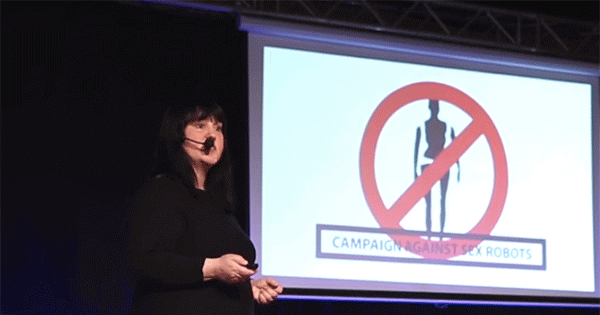
Our first response came from Dr. Kathleen Richardson. Largely known for launching the Campaign Against Sex Robots, she is a Senior Research Fellow in the Ethics of Robotics at De Montfort University in the United Kingdom.
[box type=”shadow”]
Artefacts can’t have sex because they are not alive. A living person can use an object to engage with their own sexuality, but it’s non-reciprocal and non-interactive. The object is not participating in any sex because it’s not alive, or sentient. You can add motors so a robot can move, and put voice programs into it so it can ‘speak’, and silicone skin so it feels humanlike, but none of these things mean anything to the doll/machine. The robot is no different from a chair, except its form is humanoid and it can move about on its own. Before robots, many cultures believe(ed) that the wind was alive because it could move and people could feel it but not see it. They could see how the wind could act on them and the world around them. But the wind is not doing anything. It’s not trying to hurt humans, or to help them, it is used by humans as energy or it can destroy.
This relates entirely to the sex trade. In the sex trade, people (mainly men) are able to buy the bodies of other humans (mainly women and children). In prostitution and pornography, mainly women can be looked upon as instruments of gratification – women though are not instruments. Women and children are not artefacts, but they are related to as if they are. Hence it’s not a big step for some people who operate inside this dehumanised world view to continue making these errors of judgement about what is alive and what is not. The sex trade has nothing to do with sex, but with business and abuse. Sex, when it happens between people, should be consensual and because we are human, it must actually be reciprocal. In ordinary relations, adults that are selfish lovers may engage in sex that’s non-reciprocal, they made be called bad lovers. But when it becomes formalised through buying and selling access to human bodies, it is no longer sex, but slavery. We need to stop thinking about slavery as plantations, chains and colonialism, slavery, of course, includes all these things. What slavery is looking upon a living, breathing, sentient human being as an instrument and relating to them as though they are instruments.
The problem with mechanical dolls is they perpetuate ideas that are harmful to society – that sex is instrumental and not relational. I’m not concerned about the objects, but the impacts on humans. If you keep sex outside of reciprocity, you get rape and murder of women and children.
[/box]
Interested in hearing more of Richardson’s views on the ethics of sex robots? Watch the video below of her speaking at a recent TedX event in Belgium.
Image sources: TedX Talks