



Motorbunny and Lovense speak on emerging trends and digital intimacy.

As we emerge from the first wave of COVID-19, there is a growing segment of the world not immediately rushing back into interpersonal, coupled sex.
Instead, many, by relying upon remote sex play, are doubling down on the virtual technology and remote conferencing now dominating our daily operations.
Adoption of sex as a more hyper-sensational, and less physical, experience, has grown. A full adaption of sex as both an in-real-life, or uniquely augmented experience, is likely but requires significant technological innovation.
Motorbunny and Lovense are companies at the cutting edge of leadership in the space. In talking with both companies’ leaders, a sense of how this fascinating innovation evolves an essential human act emerges.
Sex tech boom in virtual ecosystems

“There are more people than usual buying digitally connected and big-ticket sex-life products,” says Motorbunny’s Chief Marketing Officer Craig Mewbourne.
Motorbunny produces automated, saddle-style personal pleasure machines. They, alongside Lovense—a Hong Kong-based teledildonics sex toy manufacturer known for Bluetooth-controlled smart sex toys—have impressively already created the path to our collective, and fully hyper-sensational, sex lives.
Three years ago, Motorbunny developed the LINK mobile app, which allowed for Bluetooth-enabled long-distance control by a partner. In 2019, LINK’s technology was enhanced with the development of the similar to “Flappy Bird” iPhone game Fappy Bunny, which gives the player a direct, erotic thrill while doing all that flying and avoiding.
RELATED READ: Feel the ‘G-thrust’: Motorbunny’s Hybrid Sex Saddle ‘Buck’ Thrusts and Vibrates
Moreover, Lovense’s remote technology has invaded the interactive cam show industry, too. Extensive gamification, connecting multiple toys, and full integration with 20 leading cam sites places them uniquely at the forefront of the augmented sexual reality space.
In every way, every day, a digitally enhanced sex life without a partner physically present is entirely possible.
At present, Lovense owns 50 tech patents worldwide—one of which covers tip-controlled sex toys—plus offers eight unique sex toys.
With a mission statement that advocates “Sex Tech for Every Bedroom” as a goal, the last decade for the company has seen them successfully create an ever-mainstreaming virtual ecosystem that allows the company to enter into new e-commerce platforms consistently.
Digital sex products for intimacy
The COVID scare has not slowed either Lovense or Motorbunny’s bottom-line growth. There’s something more holistic at the core of both companies’ products that grown the connective tie from brand to the consumer.
“At its core, Lovense’s products enrich sex lives and emotional bonds,” says Lovense CEO Dan Liu. He continues, “I would suggest opening up your mind to the experience of remote play, where we have something for everyone.”
Motorbunny’s founder Caleb Thompson feels similarly.
“Honestly, few are lucky to always share a bed with the person they most want to be with, intimately. From deployed military personnel to differently-abled people, and now those fearing the coronavirus, Motorbunny’s products allow those who can’t connect for physical intimacy to explore their relationships uniquely, in a safe manner.”
Even deeper, Motorbunny’s Thompson and Mewbourne, when asked about the growth of Motorbunny’s products, offer an intriguing view of the future.

“We’ve seen this first grow amongst gamers and gadgeteers forming forward-thinking communities around the idea of gaming and sexuality,” they note.
They add that Fappy Bunny’s success, as well as the development of a relationship between the company and Doc Johnson’s “Vac-u-Lock” toy line, will turn more early adopters into full adapters of enhanced real-time sexual experiences.
“Zoom users forced to virtualize everything from school, to workouts, to happy hours, will likely next virtualize sex, we’d imagine,” they state, looking forward to Motorbunny’s expansion.
Regarding the long-term benefits of the post-COVID sex industry, Lovense’s Dan Liu and Motorbunny’s Caleb Thompson are excited.
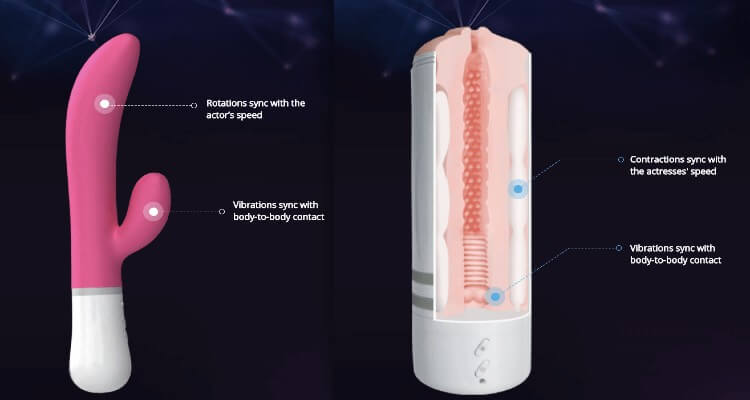
“Sex partners that are quarantined in different locations are maintaining video, audio, or text chats during play,” Liu notes. “Two of our toys, Max 2 and Nora, also include real-time motion sensors that respond to each other’s movements,” Lovense’s CEO adds, highlighting advancements.
Contemplating the best facet of a future where augmented, hyper-sensational sex is a regular part of our sex lives, Motorbunny founder, Thompson, pauses and offers the following, a smile in his voice.
“We’re going to see the development of people comfortable in having more personal, sexual situations where people’s feelings aren’t hurt. You get to choose ‘a little more,’ “a little less” or “just right.” Eventually, we’re working towards this being very much an ideal, life-like experience.”
Image sources: Jenna Owsianik, Lovense, Motorbunny