


No one should have to be made “better” in order to be accepted and desired

On the receiving end of media age discrimination, fitness guru Elisabeth Sparkle (brilliantly portrayed by Demi Moore) is devilishly tempted by The Substance, which will ultimately prove to be a literally bleeding-edge, illicit treatment promising to spawn a “younger, more beautiful, more perfect” variant of herself.
Needless to say, it all goes grotesquely and disturbingly awry, culminating in a guts, flesh, and bloody body-horror jamboree of epically disgusting proportions.
Succeeding as a daring, dark social commentary or not, The Substance puts forward an engrossing idea: would interacting with a different version of yourself be, as the film suggests, horrific or rather nurturing, self-affirming, and sexually enlightening?
“Pretty girls should always smile!”
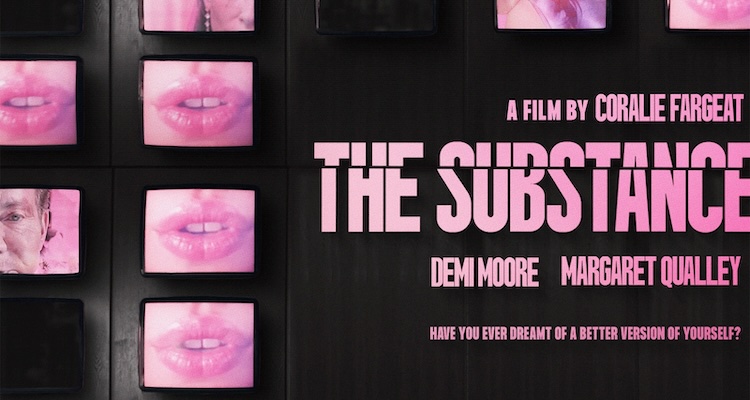
Produced, directed, and written by Coralie Fargeat and co-starring Margaret Qualley as Sue, Elisabeth Sparkle’s perfect alter ego with Dennis Quaid in an over-and-over-and-over the top portrayal as their toxic television producer.
The Substance has garnered mostly positive reviews with a few, such as El País’ Javier Ocaña comparing it unfavorably to the thematically similar, more highly regarded John Frankenheimer film, Seconds.
:
While the latter employed extensive plastic surgery to transform the tired, stodgy John Randolph into Rock Hudson, his idealized self, The Substance takes a less grounded, more Cronenbergian approach with Sue physically emerging from Sparkle’s body and must exchange places once a week or … well, things could and do get messy.
The core message of both is to love and accept oneself, which comes too late in Seconds and not at all in The Substance.
Dancing with yourself

What if we could someday develop a more emotionally fulfilling, even sexually liberating way for people to come face to face with who they truly are, not who they think they should be?
How we might pull this off is less important than what we’d possibly take away from the experience. That said, AI-enhanced virtual or augmented reality could provide an effective option, especially since it wouldn’t be necessary to actually construct or manufacture another but merely study and then approximate your personality.
RECOMMENDED READ: A Touching Tomorrow: Why Future Relationships Will Be More, Not Less Intimate
Branching off from there, interacting with a virtual counterpart might be therapeutic in coping with low self-esteem issues, being able not just to examine and appreciate your body but open up to someone who knows you as well as you know yourself.
The same may be true for sexual exploration, including making adjustments to one of your copies, such as its memory and physical parameters, to alter its gender expression and, from there, provide an exciting new sexual world to discover.
If you’re thinking we’re treading into creepy territory, keep in mind it’s basically masturbation with a few extra steps, something that has never been physically or emotionally unhealthy.
As this Men’s Health article puts it, “In addition to feeling ridiculously pleasurable, masturbation also has several health benefits, from lowering your risk for certain diseases to boosting your satisfaction during sex with a partner.”
You and me—

Have you ever wanted to do something but, for whatever reason, don’t have the time or are overly concerned about the bad things that might happen?
With another self to play with, why not send it out in the world as your proxy, which, as it’s a version of you could report on whether it had a good or not-so-good time?
Looking further ahead, we might reach a time when you and your copy—or a whole multitude of slightly or significantly modified copies, plural—wouldn’t need to talk but would merge their memories.
Imagine the new insights you’d gain and how much you might learn about who you are. It’d be like test-driving different versions of yourself, comparing what life is like for younger or older, the taller or shorter, the vulva or penis-equipped, the straight or gay versions of you.
—and we are all together

My biggest problem with The Substance is its needless cynicism, dodging what could’ve been a poignant moment of self-love for nothing but gore for gore’s sake hollowness. At least in Seconds, the protagonist is granted a fleeting moment of emotional clarity.
Worse, The Substance mocks what’s perhaps the most emotionally uplifting and healing crucial thing anyone can do: to look into themselves and see not flaws or imperfections but a person worthy and deserving of love.
Image Sources: Depositphotos, IMDB